
Breast cancer lesson number 43: Cure, Help, Empower, Me to Overcome = CHEMO

With the embryos now packed away in the freezer, one pixie haircut and one PICC line insertion are all that stand between me and chemotherapy. Cycle number one is planned in for next Wednesday and, I must confess, I’m already trying to imagine the side effects. Up to now, apart from a bit of pain, a lot of needles and enough drugs to stock a pharmacy, I have felt well. A week today, whether I like it or not, that’s all about to change.

They say the fear of chemo is often worse than the act of going through it. All I can say is, let’s hope they’re right (and that it’s not the cancer equivalent of ‘childbirth is fine’ so we all go into it with blind optimism). I have a rather vivid imagination and it’s currently in overdrive. This is in no small way to do with the consent form – or should I say dossier of potentially debilitating side effects. Beware drugs that come with consent forms! After seven pages listing out all the life-changing conditions I might end up with, it began to hit me that this is no normal prescription drug. This might actually be a bit grim.

For those wanting to know a bit more, chemotherapy is a systemic treatment using anti-cancer drugs. Its aim is to go after cancer cells in the whole body (not just the breast) and interfere with their ability to divide and grow. I will be going through what’s called adjuvant chemotherapy. This means it’s an additional treatment to reduce the risk of breast cancer returning after it has been removed (in some cases people have chemo before surgery – known as neo-adjuvant chemo – to slow the growth or shrink a tumour).

So, what awaits me in the chemotherapy chair? I will be undertaking something called the FEC-T regimen. First, I will enjoy three three-week cycles of FEC (lucky me). This is a combination of the following drugs:

1)    Fluorouracil (or 5FU)
2)    Epirubicin (a nice red liquid)
3)    Cyclophosphamide

Then, once I have got used to the way my body reacts to the above drugs, I will  move on to T or Docetaxel (one brand name is Taxotere, hence the letter T). This takes longer to administer and stays in the body longer (it gets better and better). And, I mustn’t forget the supply of anti-sickness drugs and steroids you get thrown in to keep said chemo drugs company.

In truth, the drugs are just words. It’s the list of side effects that leaves an impression. Everyone is different and no one knows how they are going to react. I know I’m strong, I know I’m positive, I know I will work when I can – and my consultant seems to think I’ll be just fine.

Bearing in mind, you probably wouldn’t take a paracetamol if you gave the pill packet too much attention, factsheets and side effects booklets are to be regarded with some caution. I will probably get some side effects, but if I get a lot, I will be more than a little unlucky and will be trading in my body for a better model at the next available opportunity.

The potential effects are many and varied. Rather than plough back through the consent form, here is my edit of the highlights (or lowlights depending on how you look at it):

1)    I will lose my hair: it seems the cold cap that is available will merely delay the inevitable, so I am going to lose my hair in style! Pre-chemo pixie is planned for Saturday and then, by the end of April, it will probably have disappeared. I am not particularly worried about this, am enjoying shopping for hats and am waiting for an opportunity to stand on a cliff with my bald head. Quite fancy not having to shave the rest of my body for months on end and it will, as a friend said, be interesting to see the shape of my head. My only fear? It growing back grey. At 32!

2)    I will get constipation: I doubt I’ll be able to beat eight days after hip surgery (not sure I want to try) so it will be back on the Laxido I’m sure. Whoop! You can also go the other way (now that would be a change!).

3)    I may get an infection: if my white blood cell levels drop, I will be more susceptible to infection. I plan to avoid the Underground where possible and have been acquainted with my new best friend, Mr thermometer. Apparently, if my temperature goes above 38 degrees, I will need to get to the hospital… and fast!

4)    I may vomit: having only vomited a few times in my life, I hope my strong constitution stands me in good stead. I certainly won’t be eating my favourite foods around the sessions, just in case I see them again ­– and then never want to eat them again. I hear the anti-sickness drugs can be effective but they can cause constipation (see 2).

5)    I may get fatigue: it’s fairly common, and the cumulative effect of all the treatment may take its toll.I plan to walk as often as I can and, of course, not operate any machinery if I feel tired (maybe just a kettle, a TV, a computer and a mobile phone).

6)    My sense of taste could change: I must say, I am intrigued by this side effect. Some say things taste like metal (yum) and others say they become addicted to sweet things. I better make sure I don’t overdo the baking, just in case. Let’s hope I don’t get too many ulcers and sores (another joyous side effect), so I can actually eat something.

7)    Docetaxel can cause bone pain: If it’s anything like my original hip pain or nerve pain, I will be willing these cycles to end!

8)    My hands or feet might start to tingle: This would be another treat from the wonderful T and is known as peripheral neuropathy. I am quite fond of my hands.

9)    Chemo brain: Chemo, if you’re listening, please don’t take my memory. I love remembering birthdays and running through my to-dos in my head. Take my memory and you take a big chunk of me. That’s not part of the deal.

All that, and I haven’t got started on heart problems, fluid retention, sun sensitivity, allergic reactions, blood clots, infertility or nail changes (or the side effects of Zoladex, the drug already in my system).

The truth is, by putting it out here in post form I wish to now close the A-Z of scary chemo effects. I will smile as the red liquid approaches. I will smile at my chemo nurses. I will smile as I write my first post-chemo blog. I will keep smiling until one of these things makes me smile no more.

As of this moment, I plan to take control of chemo. In an attempt to go down smiling (or better, not go down at all), I am in the market for chemo tips (I will write a post compiling them all later this week). Thanks to some beautiful friends, I have sleep caps, an inflatable bath pillow, nail varnish and queasy drops ticked off the list. I have senna. I have a toweling robe with which to dry myself and am on a mission to find the tastiest ginger nut. If you have a tip you think may help me stay strong and positive, please get in touch. I am willing to try, experiment and do anything (within reason), if I end up with a big smile on my face.

I was going to call this blog post ‘Know your enemy’, but when I finished writing it, I realised it’s wrong to call chemo the enemy. Cancer is the enemy and chemo is one of good guys (even if it likes to knock you down a few times along the way).

Here’s my deal. I’ll give you my hair, but you’ll have to fight me for everything else.
Breast cancer lesson number 42: Make your next appointment a real treat

If my diary is anything to go by, I can tell you now, NHS staff are busy (and I mean busy). Let’s face it, when undergoing active treatment, a week without a trip to the hospital (or a least a series of letters) can seem a bit disconcerting.

Stood waiting for the nurse to puncture me with a giant needle and implant of Zoladex this morning, however, I was hit not by the fact it was my third appointment of the week and it was only Tuesday, but by the fact that it was before 9am and the waiting room was packed. On each warm seat was a patient (or supportive shoulder) with their own story, their own medical history and their own treatment plan. Each one of those patients needed time. But, when you have a waiting room overflowing with people, time is the one thing in short supply.

I am in awe of the NHS. This has nothing to do with the number of needles that have made it under my skin over the last 32 years, the eight general anaesthetic procedures I have now racked up or the phone system that you do occasionally get lost in. This has everything to do with the level of care that I have received – and continue to receive – on a daily basis. It’s the breast care nurse who attended my oncology appointment yesterday just because she wanted to catch up with me. It’s the surgeon who stopped me in the corridor to tell me I was looking well. It’s the student nurse who took me to the toilet seven times in one day on the ward and gave me a wonderful shower when I couldn’t move properly. It’s the receptionist who said how great it was to see me smile. See the NHS as a large, flawed, headline-making system and you miss the point. The NHS is an awe-inspiring service filled with people who give over their lives to make the lives of strangers just that little bit better. Don’t believe me? I challenge you to go and sit in an oncology waiting room. Then, you won’t disagree.

The trouble with cancer (like so many serious and debilitating illnesses), however, is that appointment times and treatment plans are only half the battle. A consultation provides merely a window into the life you are leading and each one is often determined by the way you are feeling when you get up that day. Away from the bright lights, the smell of alcohol wipes and the understanding faces, when it’s just you and the ‘big C’, it’s easy to feel alone and invisible. The experts are working tirelessly to save your life and reassure you at every stage. They can’t be there to help with through daily exercises, to rub oil into your scars or support you as you shape a new life plan.

I am a great believer that the more positive I am when I embark on a new course of treatment, the happier I’ll be both going through – and at the end of – it. That’s why I decided early on that I needed to find a place to go where I could be treated (in a pleasurable way), supported and encouraged to rebuild my body and my life (with not a needle in sight). The good thing about living in London is, it didn’t take me long to find it. It’s called The Haven, and I have just spent the day there exploring the wonders of Qi gong and discovering a few nutritional secrets – and surprises.

Haven by name and haven by nature, the centre is designed to help anyone affected by breast cancer. Here, deciding your treatment plan is less about the size of your tumour and more about whether you’d prefer to try a bit of homeopathy, Shiatsu or craniosacral therapy. Although there are currently three centres, this is a charity with no geographical boundaries. The therapists will skype, call, email or meet in their attempts to reach as many patients as possible. It’s the care that starts when the NHS consultation room door closes.

I learned some interesting things today, not least about blood sugar management. Here are a few fast facts to tease your palate:

1)    Cinnamon mimics insulin (will be sprinkling more liberally in future)
2)    The health benefits of turmeric are only felt by combining it with black pepper
3)    Cooking with lard is not always a bad thing (in fact cooking in lard is considered better than cooking with vegetable oil)
4)    My desire to have eggs with everything could work in my favour
5)    Apparently, try a bit of raw butter and you’ll never go back
6)    Herbs and spices are a girl’s best friend. Not only do they pack meals with great flavours, they’re superb for the body too.
7)    I drink too much tea (and wine)

I came away feeling relaxed, inspired and with a burning desire to eat porridge for breakfast all next week. Talking of food, I can confirm there is actually no fat to be grabbed from my tummy currently (I appreciate this has been engineered, but it still felt good to hear it). The nurse this morning remarked on it and I was enjoying this news until I realised it wasn’t actually a compliment – it was a problem (that was where the giant needle needed to go). Thankfully, my left side stepped up to the table. All I can say to anyone having the Zoladex implant is don’t look at the needle (especially not if you’re not having cream to numb the area)!

Today taught me that it’s healthy to see more than the hospital waiting room. Fill your diary with things that make you smile and appointment times with only positive side effects and you’ll find you’re a lot stronger when it comes to facing the milestone meetings and sharp and increasing-large needles. You’ll feel better and, so too will the team dedicated to helping you get through each treatment stage.

Let the hospital save your life and the Haven (or an equivalent near you) help you get your life back.

NB: In case you’re interested, we got seven embryos. We may never have to use them, but they’re in the freezer for the next decade!

Breast cancer lesson number 41: The injecting is worth it

Eight has always been my lucky number. And, I am delighted to report, it seems to be not just lucky in life, but lucky in producing life. That’s right, the surgeon and embryologist have managed to extract eight eggs. By lunchtime tomorrow, we should find out how many of these eggs have been turned into embryos. There’s a one in 20 chance it will fail, so let’s hope the odds are in our favour this time after so much bad cancer-related luck.

The egg collection procedure (or what I saw of it) is nothing to fear. First, you arrive in your cubicle, get into a gown, foam slippers and a trendy mesh cap. Then you answer lots of questions, confirm consent and, in my case, pop a quick suppository in (it was either me or the anaesthetist doing this and I could tell by the look on his face that he’d rather it was me doing the honours). I obliged as he was the magic anaesthetist who’d managed to extract blood from me just a week ago.

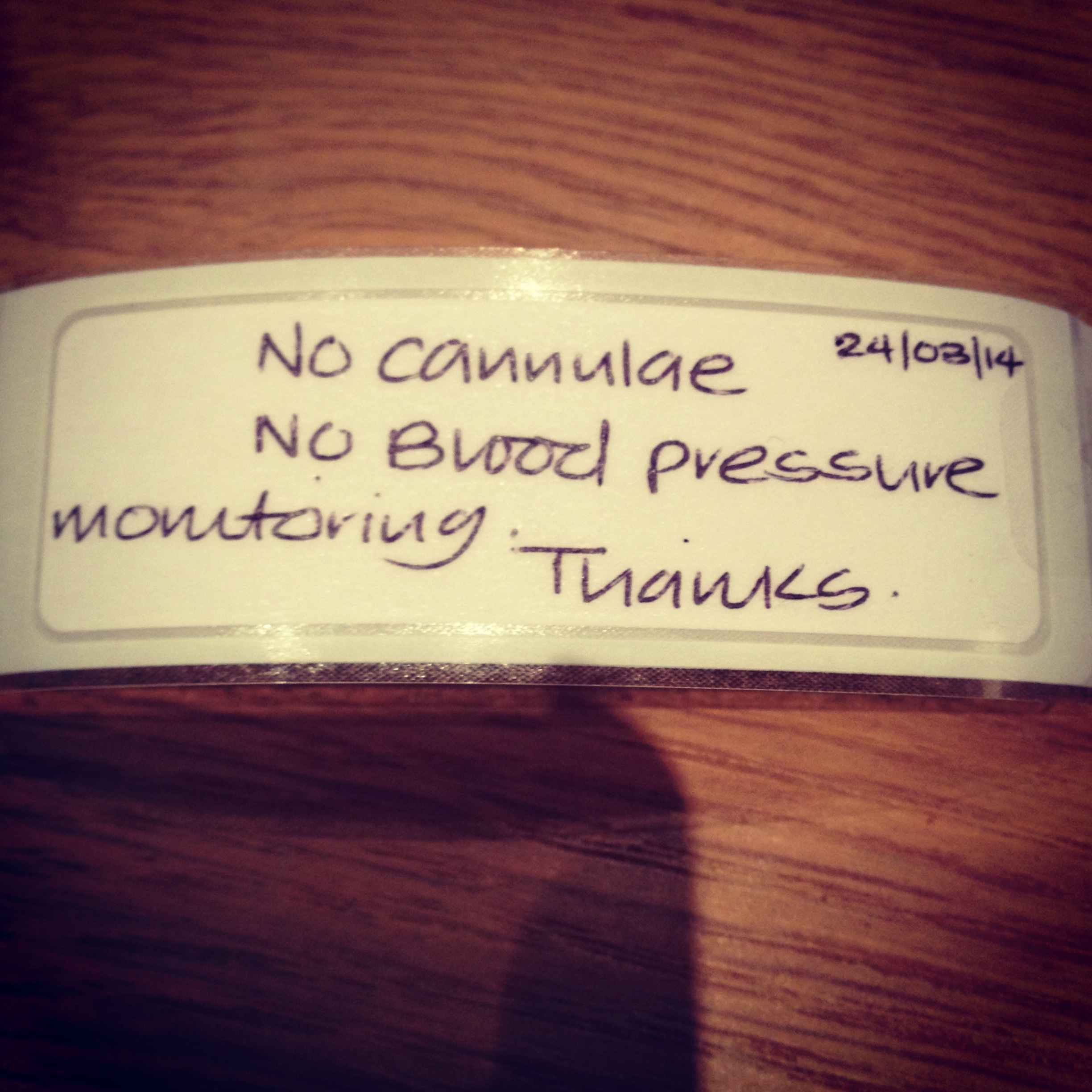
The procedure room itself is the first theatre-like room I have ever seen (usually I get knocked out in a room nearby so I don’t get to see the monitors, team and sets of scrubs). Due to the fact it’s the first time I have been without my bra and corset for an extended period, they let me position myself on the bed, before attaching heart monitors, oxygen and a cannula. After a little gentle persuasion, the team took enough blood out for themselves and the oncologists so I avoided two blood tests today – and further bruising on my sore-looking left arm. Right arm was off limits as this second band shows.

Image

The last thing I remember is a syringe worth of happy relaxing juice and a further syringe of general anaesthetic. After that, they stuck a needle in my ovaries, extracted the eggs and fed me a nice cocktail of morphine and paracetamol. I was back in my cubicle with a packet of biscuits and a nice cup of tea in no time and, am now back home, back in the corset and rejoicing in the fact stage two is pretty much done. Just have to drink three litres of liquid a day (tea doesn’t count sadly) to flush my system – and wait for that embryo call.

You’d think after all this ovarian stimulation, my body might get a day off. Sadly, the oncologist I met in the morning had other ideas. My ovaries may have been swollen with eggs today for baby-making brilliance but, as of tomorrow morning, they’re going to be shut down completely until August (part of fertility back-up plan part two). Tomorrow morning, a lovely nurse at the hospital will be popping an implant under my tummy skin to release a drug called Zoladex. This clever drug (released over the next four weeks, after which I will need another implant) is designed to send me into a fake menopause. Chemotherapy can’t kill something it thinks is already dead. While I can’t say going through the menopause twice (first time at 32 at the same time as chemo) is particularly attractive (just imagine the combined side effects), if someone gives you the chance to protect you’re ovaries, you’ve got to take it. I will be well-versed in hot flushes when the menopause happens for real, that’s for sure.

As well as putting my body through five Zoladex implants, there was one further drug-related revelation in oncology. It seems that because of the fact the cancer had spread beyond the breast and into tissue surrounding the lymph nodes, I will be taking the anti-oestrogen drug for 10 years rather than five. This means that the end of treatment will be 2024 at the earliest! The good news? We should be able to come off it to try for children before the 10 years is up. Sounds a bit like extreme family planning to me.

With the eggs out, the countdown to chemo is now on. April 2 is D-day (or destruction day) and 31 March the day when the PICC line goes in (meaning four months without blood test needles). Stage three is in sight at last.

So, let’s hope we get those embryos in the freezer and let’s hope cancer doesn’t take another chunk out of my femininity. Having taken my boob, it’s already got its eyes on my hair!

Breast cancer lesson number 40: Cancer treatment is like a punishing endurance challenge. Savour those checkpoints

For me, breast cancer treatment is a five-stage race. First, you lay down on a slab and get rid of the troublesome cancer. Stage one, tick (if we ignore the fact I have to get a little cosmetic adjustment at some point in the future). Next, you get to store some babies in the freezer. Stage two, tick. With fertility over, your veins get a high dose of body-killing (or life-saving) chemo drugs. Stage three, tick. Once your body has started to recover, you get a blast of high-energy radiation. Stage four, tick. Then, if you’re still standing, you say goodbye to daily hospital visits and hello to daily doses of oestrogen-blocking pills. The finish line is currently scheduled for some time in 2019, and I have no plans to go back in training after that! After that, the only races I’ll be tackling will be charitable ones!

Tomorrow is the end of stage two. That makes it a special day (one refreshing checkpoint in this epic race). With the end of stage three planned for mid-August, it will be a while before I once again feel like I am one stage closer to the home straight. Chemo is a long stretch and I know I’ll need all my energy just to get to the end.

I have to say, sitting here with a bloated stomach that makes me wants to live in the toilet, tomorrow cannot come soon enough. I certainly don’t think a body corset, tummy scar and enlarged egg-stuffed ovaries – combined with a functioning bladder and stomach – belong together. I feel like someone is bouncing on my stomach and there isn’t enough skin to go around. Starting to find the idea of a needle in my ovaries rather attractive.

What did I feel like after completing stage one? First, there was pain. Then, there was immense relief. I’d like to say I was dancing around my hospital bed. But, let’s face it, I could barely stand. How do I think I will feel if we are lucky enough to pop some embryos in a freezer bag? First, I will be happy that the baby back-up plan is in place. Then, relief that I can walk from the living room to the kitchen without needing a wee. (I also quite like the idea of a fridge that isn’t full of syringes and vials.) Neither of these sound like great moments of celebration or markers in history. But, when there is life at stake, you’ve just got to be happy you registered for the right race and are running in the right direction.

Cancer checkpoints don’t come along very often. When they do, whether you’re on morphine or Merlot, you’ve got to grab them, get the most out of them and use the happiness (or relief) they bring to take you forward into the next stage. I may be more likely to be raising a mug of tea than a glass of wine at the moment (last night aside), but I am determined to make sure each one of these stages does not go by unnoticed (I think a lot of people design a sign to mark their last chemo session, so that’s on the to-do list for stage three). You may lose a few consultants and nurses along the way, but that doesn’t mean there are any less people rooting for you to succeed. There are just a few less appointments to attend, a few less needles and a few less worries to occupy your fact-filled mind.

This is a race I will complete – and there will be a big smile waiting for me at the finish line (and probably one of the many bottles of engagement champagne currently gathering dust in the cupboard). I am not going for a personal best and there won’t be a medal at the end of it, but there will be life. I hope you’ll be there to cheer me home. 

Breast cancer lesson number 39: Timing is everything!

Image

This is it. Inside this box is the last injection I have to administer myself as part of the fertility process (we won’t talk about the chemo-related ones just yet). No more Menopur. No more Cetrotide. Just two Letrozole anti-cancer pills and an injection stand between me and being able to have my eggs collected at 3.30pm on Monday.

Ovitrelle is a trigger injection. It stimulates the final maturation of eggs in the ovaries. That means, once I have jabbed myself with this last needle, there is no going back. I will be on the slab on Monday and, with any luck, we’ll have embryos in the freezer soon after that. The procedure to extract these eggs is something I have just read about (although wish I hadn’t) and is something I will not be reporting here. Ok, so it’s not on a par with having your stomach cut open and the boob chopped off, but I am glad I am asleep for it. If curiosity is getting the better of you, click here for the science, but please don’t ever bring it up over dinner! 

For the trigger to be effective, timing is everything. So, mum will be keeping me company tonight until 2am when I can deliver the final and important dose (she might get to watch Les Mis from start to finish as a treat). Then I get a day off drugs tomorrow (my body will probably go into shock), a light breakfast of tea and toast at 6am on Monday and a date with a cannula and some IV sedation later that day.

Of course, when the nurse called, I had my priorities right. One, what do I do with the sharps box of syringes that is currently making the kitchen look untidy? Two, what to do with all the leftover drugs in the fridge? (Sadly the answer in both cases is to bring them with us, which means we’ll be heading to oncology looking like a portable pharmacy or like we’re about to have a picnic in the waiting room. Let’s hope I get to keep the cold bag!). Three, if I’m at the hospital all day, when do I take my suppository? (There was a lot of laughter attached to that answer and you really don’t want to know more). And four, (arguably the most important question) can I have a glass of wine with dinner? I am glad to report, I got a whole-hearted ‘absolutely’ in response! (Better set the phone alarm for 1.55am just in case)!

There is one last – and rather unexpected – obstacle to overcome in this fertility challenge. It’s brown, it has a tail and it likes to enter our kitchen at night and camp out under the dishwasher. We’ve being trying to get rid of our visiting rat for nearly two weeks, but we do have an understanding that we just don’t enter its trap-filled and Nutella-fuelled lair at night. With refrigerated drugs to take, I think I may have to take a torch and some back-up if I stand a chance of getting to the pre-filled syringe without getting nibbled.

Oh yes, don’t think just because you get cancer, you can avoid first world problems. I have a list!

One last needle, one last shot of drugs and one chance to make embryos. Cancer won’t wait for a second cycle. We have everything crossed!

Breast cancer lesson number 38: If at first you don’t succeed, try, try again

Today was supposed to be a simple day. First, head to assisted conception to try and schedule my egg collection at a time that meant I could keep my oncology appointment on Monday too. Then, head to the breast clinic for the second of my arm measurements in the Lymphoedema clinical trial. In short, have a chat and stretch your arm out straight. Now, how hard could that be?

As it turns out, pretty hard. Nothing is ever quite as simple as it seems. Take assisted conception. It seems the Monday egg collection list that ‘isn’t planned until tomorrow when they know how many people are on it,’ is already pretty much full for the morning. I can only assume that has something to do with the volume of private patients on the collection list. Currently, I don’t appear on any list, but am just hoping my request to schedule it around my noon oncology and blood test appointment is taken on board, otherwise oncology might not be too pleased. Two blood tests, one suppository, one IV sedation, one egg collection and more discussions about toxic drugs await me on Monday. I’m already excited!

Determined to achieve something today, I set off to the breast clinic, practising my arm exercises on the way. As anyone who has read lesson 11 will know, I have dedicated my arm to science in order to help those trying to detect Lymphoedema as early as possible. The challenge for today? Can I get my right arm out as straight as I did a month ago? The answer? No chance. I tried (twice) and failed (twice). We even made a little graph out of the data to show me just how far off I was. My homework? More exercises until my arm is poker straight. They have two weeks to get the reading. I have two weeks to walk my arm up a wall and get it just that little bit straighter – and higher – than it is at the moment. At least I got my height measured so it wasn’t such a wasted trip for measurement man (not something I could fail at so easily)!

For those of you thinking: ‘but I thought she had breast and tummy surgery, so why is her arm hurting?,’ don’t worry, you haven’t missed a chapter. My restricted arm movement is as a result of having my lymph nodes removed (thankfully I did, given the cancer in one of the infected nodes had already spread out into the surrounding tissue). The surgery has given me a partially-numb, quite swollen and very sore right arm. It feels like someone has tightened everything inside my arm and it needs a while to loosen up. Think alien limb (whose only friend is numb new boob), and you’re not far off. With alien arm, I can write (for short periods), I can knit (for shorter periods), I can cook (as long as I don’t lift heavy pans), I can play quoits (albeit very badly) and I can lift tea (at any time), I just can’t carry supermarket shopping or, it seems, pass clinical trial tests.

Apart from a sore arm, the one thing no ANC (which means anxillary node clearance for anyone counting abbreviations after Saturday’s lesson) patient wants is Lymphoedema – or swelling. Without the lymph nodes to drain fluid from the arm, lymphatic fluid can build up in the surrounding tissues. It can be controlled, but, once it has developed (and it can develop any time in the future), it is unlikely to ever go away.

A compression sleeve is not something I’d like to wear with a wedding dress, so I am currently surrounding myself with as many tips and hints as possible to avoid getting injured or infected on that side. No one really knows what causes Lymphoedema (hence why I am on a trial), but this never-again-on-right-arm list should help reduce the risks:

The banned list

1)   Soap that dries out the skin (unperfumed moisturiser is a must for the kit bag). I think I can handle that.
2)   Very hot (or very cold water). They mention steam rooms and saunas, but am hoping occasional use is ok.
3)   Acupuncture on ‘at-risk’ arm (plenty more places to prick thankfully)
4)   Injections (woohoo!)
5)   Blood pressure cuffs (another woohoo! Quite liked it on my leg in hospital)
6)   Blood tests (don’t I know it!)
7)   Lots of weight gain (I will try, but who knows what chemo will do to me)
8)   Walking around with robot arm (being my right arm, am desperate to use it normally, so am not auditioning for a role in Star Wars)
9)   Deep tissue massage unless practitioner is specifically trained (they really know how to take away all my fun)
10) Sunburn (I have never actively tried to get burnt, but my skin just likes turning red when it looks at the sun. This could be challenging)
11)  Biting of nails (tried once, couldn’t work out how to bite them. Won’t be starting now)
12)  Washing up and gardening without gloves (I confess, I have bright pink marigolds, but am yet to put them on)
13)  Waxing or shaving the armpit with a manual razor (am hoping chemo will take care of any unwanted hair for a while)
14)  Tight jewellery or clothing (should be ok)
15)  Heavy shoulder bags (given I love to carry at least two bags at any one time, this is going to be particularly challenging)
16)  Arm strain through digging, pulling or lifting heavy bags (sounds like permission to sit drinking Pimms while Duncan does the gardening if you ask me)

NB: Please comment and add if I’ve missed any tips

Looks like I am going to become very closely acquainted with a large tub of aqueous cream (currently being applied to my tummy and boob) and antiseptic lotion (my new best friend should I get a cut, bite or baking burn).

I may have failed to achieve today’s tasks, but I still left the hospital with a spring in my step. While measurement man was measuring my height in the corridor, my breast surgeon did a double take and, realising it was me, came along to say hello. Impressed by how straight and well I looked, he gave me the biggest of smiles and said how lovely it was to see me. It may not have been a statement based on any medical examination (and I didn’t have the heart to tell him I had failed the arm test), but his smile certainly made me feel I must be doing something right. I’ll take that.

Let’s hope I can successfully be in two places at once on Monday – and that somebody will be able to find a vein!

Breast cancer lesson number 32: Dust off your satchel, you’re going back to class!

With the volume of tests, examinations and terms to commit to memory on a daily basis, you could be forgiven for thinking you signed up to a course – not a course of treatments – on diagnosis day! Cancer, do you really need your own curriculum? And, do we all have to be graded?

Breast cancer is the biggest module you’ll ever take – and not one any of us would wish to retake or even fail. For starters, it has its own language. You may not have to get the grammar – and you’ll be forgiven for misplaced capitalization – but once ‘benign’ becomes ‘malignant’, it’s best to reach for the dictionary – and fast.

Image

First there are words that cancer has deemed appropriate to rename. I think armpit is a fairly straightforward word, but cancer thinks it should be something a bit more technical. Enter ‘axilla’! Having been acquainted with my lymph nodes for the first time, it didn’t take long to work out that they are also referred to as lymph glands or axillary nodes (when under the armpit). Why opt for one term, when three will do! And, did you know, far from just having a boob job with tummy tuck and node removal, I actually had a mastectomy with removal of the areola followed by a deep inferior epigastric perforator flap with axillary clearance? Put like that, I am exhausted just saying it, let alone recovering from it!

But, that’s not all. Once you get over the fact things have three names and that once you become familiar with your armpit, it becomes something else, stage 2 of the cancer curriculum gets thrown in. And, by stage 2, I mean acronyms. Navigate the CT, choose between the WLE and the MX and then you get to find out your ER status and whether or not you are HER2 positive (all of which is discussed at length at an MDM). That’s before you get inducted in the language of chemo (FEC, FEC-T, CMF and AC anyone?). My absolute favourite so far: FISH. Don’t be fooled into thinking it has scales and eyes. FISH actually means ‘Florescence in situ hybridization’, which is a way of measuring HER2 levels in cancer cells. Not tasty, and certainly wouldn’t go well with lemon.

Armed with my Breast Cancer Care glossary (thank you so much for creating this superb revision guide), I am transported back to the days of French A-level revision (although without the lovely nightly walks with my parents throwing around vocab). I have always liked vocab tests and like to think of myself as a cancer codebreaker. But, when it feels like you’re being home-tutored in a class of one, and you want more than anything to pass with flying colours, the pressure really is on!

Breast cancer has its very own secret after-school club. And, if you know your MDM from your MX and your DX, then you’re in (whether you like it or not). You often won’t be able to spot a breast cancer patient, but just know that there are people all over the world with new boobs (or adjusted ones) all trying to revise harder than they ever have before.

This time, it’s not about getting top grades (nobody wants a high grade cancer). It’s not about getting a certificate and a gold star (although I wouldn’t say no). This time, the reward is life – something definitely worth dusting off the satchel for!

Breast cancer lesson number 31: What you lose in dignity you gain in confidence

I lost my dignity somewhere between getting drawn on by a surgeon with a giant marker pen (in front of another surgeon and my parents) and having an unexpected internal scan at my first fertility appointment. That’s not to say that my amazing hospital doesn’t go to great lengths to protect it with their well-placed gowns and paper towels. But, when you’re picking out your clothes based on what gives people ‘easy access’ you know it’s pretty much gone – and the chances of recovering it are very slim (I appreciate that may make me sound a little bit like a loose woman. But, trust me, it’s all in a good cause!)

Surprising as it may be to hear, I don’t want it back. In its place, the hospital has inadvertently given me something so much more important: a massive dose of body confidence. That’s not to say that I have a burning desire to take my top off or wear more revealing clothes (I don’t think the world would ever be ready for that). But, by encouraging me to undress at pretty much every appointment (sometimes just out of pure curiosity and kindness), I have realised for the first time that I’m happy with my lot.

Image

It may sound strange coming from someone with a large scar down her hip (and four giant metal pins inside), a scar on her neck from a old birthmark, a walk that looks like it belongs on the comedy circuit, an amputated boob (and a new imitation one without a nipple currently), straw-like hair, a scar the length of my tummy and so-called ‘child-bearing’ hips. But, every time I look in the mirror now as I massage my modifications and wash my hair, I don’t see my flaws. I just see strength.

I know I’ll never be stopped in the street or take someone’s breathe away with just one look. I know that I’ll never be able to wear short skirts and look good in a pair of shorts. I also know that when fully clothed I am just another plain Jane on a commuter train. But, what makes me smile is that, beneath the pink cardigans and the navy dresses, I am a warrior. And, if you asked me to choose, I wouldn’t change a thing (beyond getting a serious illness in the first place of course). After all, if the world wanted us all to be beautiful, it wouldn’t have invented mascara! And, I love mascara!

Beauty isn’t about having good skin, it’s about being comfortable with what you have and accepting who you are. You’ll find there’s a cream for everything else.

So, I challenge you to stand in front of the mirror this weekend and smile. Smile at the good bits (I am positive you all have something about which you are particularly proud. For me, I have always liked my eyes and my shoulders). Then, most importantly, smile at the bits that make you who you are (the childhood scar you’d wouldn’t have had if you’d listened to your parents, the finger nail that just doesn’t grow the way you want, the knee that hurts, the big toe that you always bury in thick socks).

Smile because you’re you. I wouldn’t have you any other way!

NB: if you’d like to find out more about scarring and breast reconstruction (with DIEP), head to lesson number 21.